The words behind a loyalty card.
21 terms, defined the way they are actually used behind a counter. Where a definition rests on published research the study is named in the definition rather than hidden in a footnote. None of it is a TapReward result, and the evidence page sets out the papers in full.
The card
- Digital loyalty card
A loyalty card held on a customer’s phone rather than on paper, which collects stamps or points automatically when they visit.
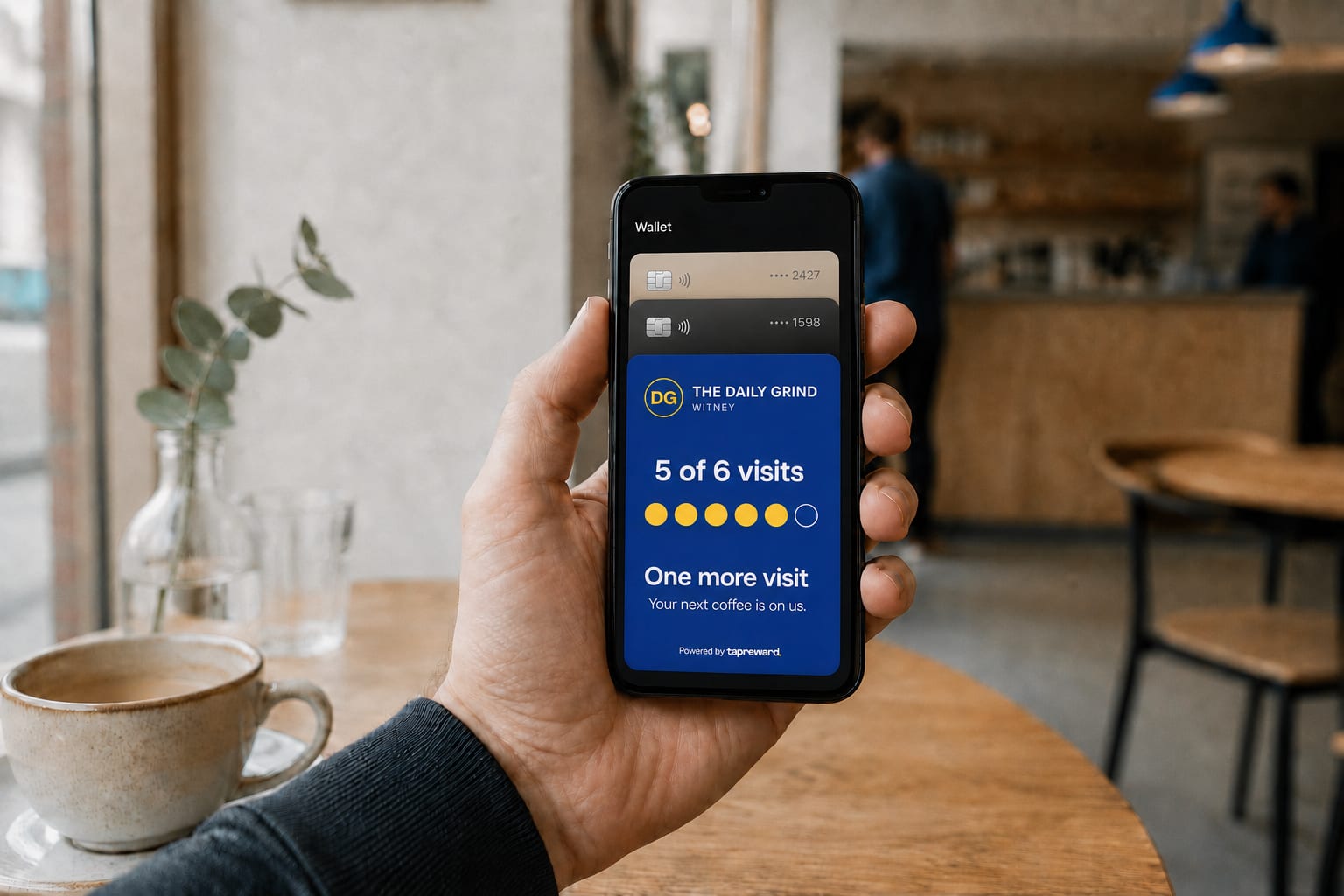
A digital loyalty card does the same job as a paper stamp card and removes the two things that break one: the customer has to be carrying it, and someone has to remember to mark it. Because the card is a record rather than an object, it also produces something a paper card never could, which is a count of who came back and when. There are three common shapes: a card inside a shop’s own app, a card scanned from a QR code, and a card held as a pass in the phone’s wallet.
See also: Wallet pass, Stamp card (punch card), Loyalty app
- Wallet pass
A card, ticket or coupon stored in Apple Wallet or Google Wallet, the app a phone already has for bank cards and boarding passes.
A wallet pass is added in a couple of taps, needs no account and no password, and updates itself: when a stamp is added, the card in the customer’s pocket changes without them opening anything. Because Apple Wallet and Google Wallet are built into the phone, a wallet pass avoids the step that loses most loyalty schemes their customers, which is persuading someone to download an app for one shop.
See also: Digital loyalty card, Loyalty app, NFC (near field communication)
- Stamp card (punch card)
A loyalty card that earns a reward after a set number of visits, one stamp per visit, rather than accruing points against spend.
Stamp cards are the dominant form of independent loyalty because they are legible: a customer can see at a glance how close they are, and a shop can explain the whole scheme in one sentence. A points scheme is more precise about value but harder to feel. The visible progress is not a cosmetic difference, it is most of why the mechanism works at all.
See also: Reward threshold, Goal-gradient effect
- Loyalty app
A dedicated mobile app a customer downloads and creates an account in before they can start collecting.
A loyalty app can do more than a card, and for a chain with hundreds of sites the download is worth asking for. For a single shop it usually is not: the customer is asked to find, download, open and register with an app at the counter, and the cost of that request lands entirely on the visits when a new customer might have joined.
See also: Wallet pass, Digital loyalty card
- Reward threshold
The number of stamps a customer must collect before earning the reward, which sets both the discount and how attainable the card feels.
The threshold is the one number that decides whether a scheme works. Set it low and the reward is generous but earned by people who would have come anyway; set it high and the card stops feeling winnable, which removes the effect that makes it work. The arithmetic is simple: one free item in ten is a 10% discount paid only to customers who visited ten times, and that discount costs nothing on the visits that never happened.
See also: Stamp card (punch card), Goal-gradient effect, Redemption
The technology
- NFC (near field communication)
A short range wireless standard that lets two devices exchange a small amount of data when they are held within a few centimetres of each other.
NFC is the technology behind contactless card payments, and every mainstream smartphone sold for the last decade can read an NFC tag without any app installed. That last part is what makes it useful for loyalty: a customer holds their phone near a tag and a web page opens, with no camera to line up, no app to find and nothing to install. It works in the dark and it works with a screen protector on.
See also: Passive NFC tag, QR code, Tap tag
- Passive NFC tag
An NFC tag with no battery, powered entirely by the field of the phone reading it.
A passive tag is a printed aerial and a small chip. It has nothing to charge, nothing to connect to Wi-Fi and nothing to fail on a busy morning, and it keeps working for years because there is no component in it that runs down. This is why a counter tag is a sticker or a small stand rather than a device.
See also: NFC (near field communication), Tap tag
- Tap tag
The counter sign a customer taps their phone against to collect a stamp.
In TapReward’s case the tap tag is a passive NFC tag inside a printed sign that sits by the till. It needs no power and no network of its own, and it holds one thing: the address of that shop’s loyalty card. Everything else happens on the customer’s phone and on the server.
See also: Passive NFC tag, NFC (near field communication)
- QR code
A printed square barcode that a phone reads with its camera, usually opening a web address.
A QR code does the same job as an NFC tag and asks more of the customer: unlock the phone, open the camera, aim it, hold steady, tap the notification. In good light with an unhurried customer that is a few seconds. At a counter in a queue, in low light, or with a phone that has an older camera app, it is the step where people give up. The two are not mutually exclusive and a scheme can offer both.
See also: NFC (near field communication), Tap tag
- First-party data
Information a business collects directly from its own customers, rather than buying it or inferring it from a third party.
A loyalty scheme is one of the few ways an independent shop generates first-party data at all: who came, how often, and when they stopped. It matters more than it used to because the alternatives have been closing, and it matters practically because it is the only customer list a shop owns outright rather than renting from a platform.
See also: Repeat visit rate, Lapsed customer
The behaviour
- Goal-gradient effect
The tendency to accelerate towards a reward as it gets closer, so the last few steps are taken faster than the first.
First observed in animals in the 1930s and demonstrated on human loyalty cards by Kivetz, Urminsky and Zheng in the Journal of Marketing Research in 2006, whose study tracked a real café’s stamp cards purchase by purchase. Customers visited more often as their free coffee got closer, and completed their cards around 16% sooner than their opening pace implied. The practical consequence for a shop is that a customer one stamp from a reward is the most likely person in the list to walk back in.
See also: Endowed progress effect, Points pressure, Reward threshold
- Endowed progress effect
People work harder towards a goal they have already been given a head start on, even when the head start does not reduce the work required.
Nunes and Drèze demonstrated this at a car wash in the Journal of Consumer Research in 2006. One group was given a card needing 8 stamps; another was given a card needing 10 with 2 already filled in. Both groups needed exactly eight washes. 34% of the head start group completed their card against 19% of the other, and they came back sooner in between. It is the reason a loyalty card should never be handed over blank.
See also: Goal-gradient effect, Stamp card (punch card)
- Points pressure
The extra buying a customer does specifically to reach a reward they can see coming.
One of two effects named by Taylor and Neslin in their 2005 Journal of Retailing study of a supermarket rewards programme, the other being rewarded behaviour. Points pressure is the lift before redemption and it stops the moment the reward is claimed, which is why a scheme measured only on the run-up flatters itself.
See also: Rewarded behaviour, Goal-gradient effect, Redemption
- Rewarded behaviour
The continued lift in a customer’s spending in the weeks after they have actually claimed a reward.
The second of the two effects from Taylor and Neslin, 2005, and the more surprising one. Their two year study found customers spent 17.5% more per week in the four weeks following a redemption. It reframes the giveaway: the moment that feels like a cost to a shop owner is the moment the goodwill is banked, which is why an unclaimed reward sitting in someone’s wallet is worth chasing rather than quietly hoping about.
See also: Points pressure, Redemption
- Redemption
The moment a customer claims the reward they have earned, and the point at which a completed card is cashed in.
Redemption rate matters for two opposite reasons. Unredeemed rewards are a liability in the sense that customers are owed something, and an opportunity in the sense that the research on post-redemption behaviour says the claim itself is the part that pays. A card that is completed and never claimed has collected all of the cost of the scheme and none of the benefit.
See also: Rewarded behaviour, Reward threshold
- Nudge
A short, timed message to a customer who has opted in, usually reminding them that a reward is close or waiting.
A nudge is not a marketing campaign and the difference is in the timing rather than the wording. Sent to everyone on a Tuesday it is a broadcast; sent to the nine customers who are one stamp from a reward it is a reminder about something they already own. The second gets read.
See also: Lapsed customer, Goal-gradient effect
The numbers
- Repeat visit rate
The share of customers who come back at least once more after their first visit, over a given period.
Footfall counts everyone who walked in; repeat visit rate counts only the ones who chose to come back, which is the number a shop can actually move. It is also the number most independents cannot measure, because measuring it requires recognising the same person twice, and a till cannot do that.
See also: Customer retention, Churn, First-party data
- Customer retention
Keeping existing customers coming back, as opposed to acquiring new ones.
The economics are lopsided and well documented: Harvard Business Review, citing Bain and Company research by Frederick Reichheld, reported that a 5% improvement in retention can lift profits by 25% to 95%. The reason is arithmetic rather than sentiment. A retained customer costs nothing to acquire again, and every additional visit is close to pure contribution.
See also: Churn, Repeat visit rate, Lapsed customer
- Churn
The rate at which customers stop coming back over a period.
Churn in a shop is quieter than churn in a subscription business, because nobody cancels anything. A weekly regular becomes a fortnightly one and then stops, and the only signal is an absence, which is exactly the kind of thing a busy counter does not notice. The practical version of the number is a list of names rather than a percentage.
See also: Lapsed customer, Customer retention
- Lapsed customer
A customer who used to visit regularly and has not been seen for noticeably longer than their own usual gap.
The definition has to be relative to the individual, not the shop. Three weeks is nothing for a customer who comes monthly and is a warning for one who came every Tuesday. Defining lapsed as a single fixed period across everybody is the mistake that makes a drift list useless: it flags the infrequent and misses the regular who quietly stopped.
See also: Churn, Nudge, Repeat visit rate
- Customer lifetime value
The total profit a business expects to earn from one customer across the whole time they keep coming back.
For an independent it is usually easier to reason about than it sounds: average spend, times visits per month, times the months a typical regular lasts. The reason to work it out at all is that it puts a number on a lost regular, which is otherwise an abstraction, and it is what makes the cost of a loyalty scheme comparable to the cost of losing four customers a month.
See also: Customer retention, Repeat visit rate
Where these come from
The behavioural definitions summarise published academic work, cited by author and journal in each entry. The full reference list, with what each study measured and what it does not show, is on the evidence page. The technical definitions describe how the standards work rather than how TapReward implements them. Why TapReward compares a wallet card against a paper card and an app, and the trade pages put the same ideas into the shape of a specific counter.